How follow the money journalism helped protect Malawi’s mining assets

Last month in a shock announcement, Malawi’s President Mutharika ordered an immediate ban on raw mineral exports.
At the state opening of parliament, the 85-year-old one-time law professor also confirmed a review of his country’s legal and regulatory mining framework plus an audit of the licence registry.
The bombshell proclamation came just three weeks after the publication of a story we developed with Malawian journalist, Jack McBrams (above) for Platform for Investigative Journalism (PIJ).
Our story, which also secured The Continent front cover, revealed the Chinese state had quietly acquired a key mining asset without the permission of Malawi’s ministers.
PIJ and Finance Uncovered exposed the very weakness in the system the president a month later said needed a fix.
It is another example of how “follow the money” training combined with intensive mentoring equips journalists with the confidence to interrogate financial documents, leading to real-world impact.

Malawi's Chief Justice Rezine Mzikamanda (L) and President Peter Mutharika in October 2025 (Photo by Amos Gumulira/AFP via Getty Images)
Joint investigation
Our joint investigation revealed that a strategically important mining site – containing more than 350 million tonnes of untapped zircon, titanium, ilmenite, magnetite and monazite – changed hands twice in two years.
It was now fully owned by two Chinese state companies.
This game of corporate “pass the parcel” was apparently news to Malawi’s Ministry of Mining.
The Ministry confirmed it had not been informed of the two ownership changes in what appeared to be a breach of the law. It promised a “fact finding exercise” that could lead to fines or administrative penalties.
As Jack and our reporter presented their findings to relevant experts, they became aware that there was unease over the ability of Malawi’s government to cope with the influx of international investors racing to get their hands on valuable mining assets.
A lack of transparency, we were told, meant there was no way of knowing if citizens were getting a fair deal for their potentially transformational resources.
Now the Malawi government has signalled its intention to act on this unease. Civil society in Malawi and beyond is watching.
The story behind the story
Since 2022, we have run over 25 seven-week eLearning courses that give journalists and activists around the world the fundamentals in how to analyse company financial statements and where to source documents.
Up until the beginning of last year, most cohorts who took this training numbered ten or more. Satisfaction from participants was extremely high.
But we spotted an opportunity - particularly with journalists from resource-rich countries in Africa - to join our training armed with a potential story focused on the extractive sector.
By reducing the cohort size, we could pair one participant with an FU mentor. Together, we would turn ideas into news as they took the course.
Last June, Jack applied to be part of the second cohort of this hybrid training and story workshop model.
Jack suggested a number of companies to look at. Our reporter assessed the companies and story potential.
Together in conversation with Jack, we found our investigative target: Mawei - a one-time private Chinese company.
In 2017, it was awarded a licence to exploit 34 sq kilometers centring on the village of Makanjira on the south east corner of Lake Malawi.
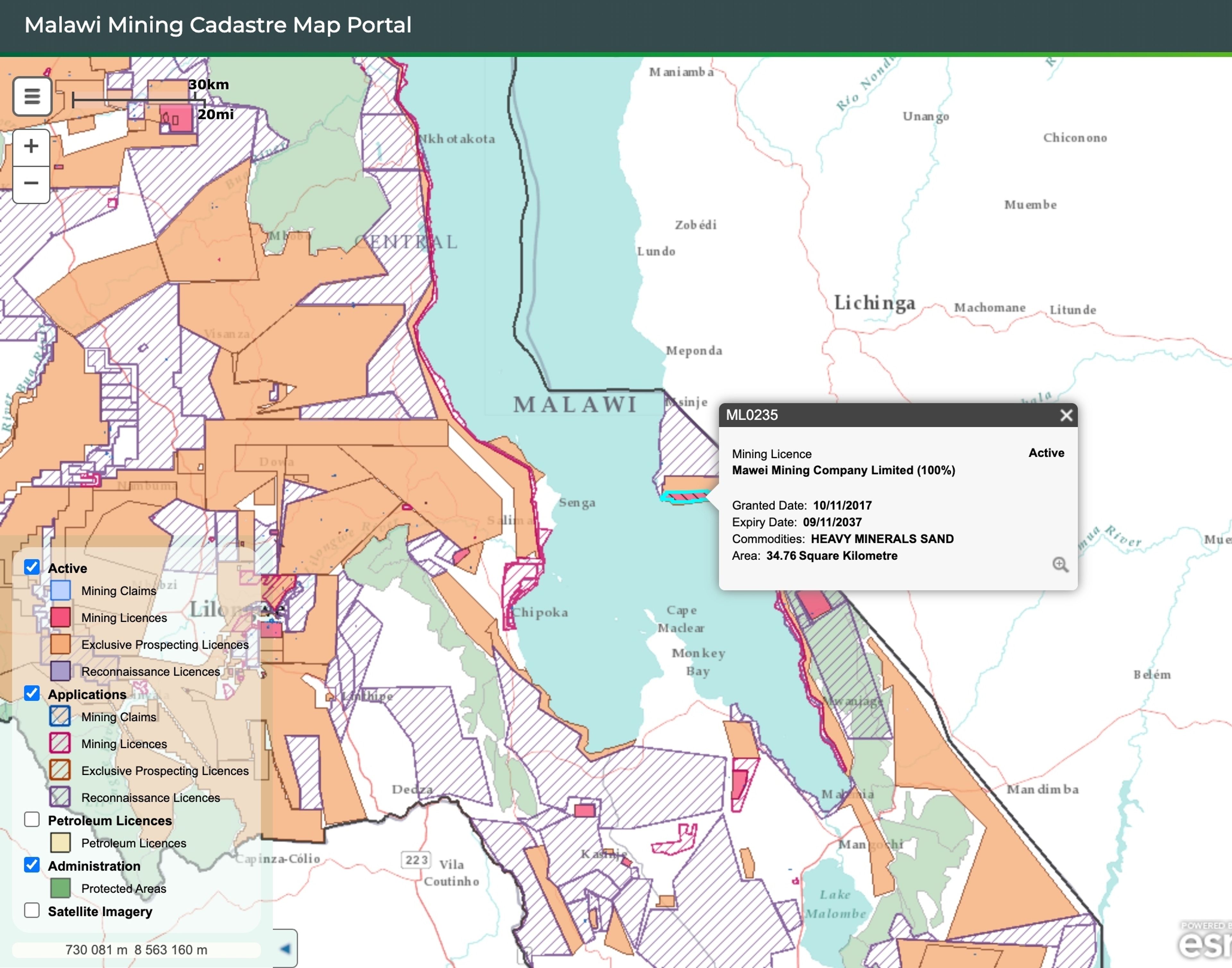
Mawei's concession, on the shores of Lake Malawi. (Credit: Malawi Mining Cadastre Portal.)
Methodology reshaped
Six years later the promise of an economic miracle for local communities and the country of Malawi had not materialised.
Logistical and power issues, according to ministers, meant the site was idle.
By searching stock exchanges in China, we established how ownership had been "flipped" twice since 2023.
Jack visited Makanjira to talk to residents and see the site for himself and, together with Finance Uncovered, wrote up the story.
"The ‘Follow the Money’ training and mentorship with Finance Uncovered were truly transformative, an invaluable turning point that I reflect on with the utmost conviction,” Jack told us.
“The team’s world-class attention to detail and rigorous mentorship have fundamentally reshaped my methodology.
“Although I have been a journalist for many years, the specific skill set required to investigate corporate structures and deconstruct company finances was a new frontier for me. This program has bridged that gap, allowing me to merge meticulous, desk-based financial interrogation with traditional on-the-ground reporting to produce investigations that are as remarkable in their depth as they are ground-shaking in their impact."

Mawei's mining concession is thought to hold more than 350 million tons of critical minerals and rare earths. (Photo: Andrew Viano.)
Looking ahead
This way of working is already delivering for journalists who take our training, producing important stories in Uganda, Zambia, Malawi and beyond.
With geopolitical tensions ratcheting, the race for critical minerals is accelerating. It means it is vital to leverage local knowledge of mining projects with financial accountability training that gets results.
We are developing this model further with partners across Africa, Latin America and Europe.
If you want to discuss how investigative training and intensive mentoring could unlock potential for impact in your team or campaign, do not hesitate to get in touch.