How Chinese state companies quietly took over millions of tons of Malawi’s critical minerals

On the far edges of Makanjira village, where Lake Malawi’s waters lap softly against the shoreline, a rusted sign stands half-swallowed by tall grass. The letters are fading, the post is tilting, but the name is still just visible: Mawei Mining Company Ltd.
“There used to be Chinese people here,” said 58-year-old farmer Alinafe Mbewe, pointing toward the overgrown path where drilling rigs once stood. “They told us this place would change. We waited. Nothing changed.”
More than eight years have passed since Mawei, then a privately controlled company, announced it had found a treasure chest of minerals in this remote corner of central Malawi. The government hailed the project as proof the country was open for business, and villagers were told to prepare for jobs, roads and electricity.
But the drills stopped buzzing almost as soon as they had begun. Today, this barren patch of earth is also testament to a deeper problem of transparency and accountability for Malawians: who actually owns this strategic mineral asset and does their government even know?
An investigation by the Platform for Investigative Journalism and Finance Uncovered reveals that Malawi’s government was oblivious as ownership of this crucial resource changed hands twice in two years, in an apparent breach of the law. This game of corporate pass the parcel means millions of tonnes of heavy sands, a major source of critical minerals, are now ultimately controlled by regional state authorities in China.
Companies that own mining licences in Malawi are legally required to seek approval from the mining ministry for any change of ownership, a law common across Africa so governments can protect national assets. As a result of PIJ and FU’s findings, the ministry pledged to investigate.
The revelations raise questions about Malawi’s ability to handle an influx of Chinese investment into its mining sector. Malawi is home to millions of tonnes of critical minerals and rare earths — essential to everything from electric vehicles to smartphones — that are at the centre of a geostrategic battle between the US and China that is playing out across Africa.
But civil society groups warn the lack of transparency in how mining deals are done means it’s unclear if ordinary Malawians will benefit from any potential boom.
“This is mineral extraction without oversight. It is modern dispossession through the language of investment,” said Joy Chabwera, programme manager at the Natural Resources Justice Network, which advocates for corporate transparency.
Mawei’s managing director, Armstrong Cao, said the company “always fully compl[ies] with the laws and regulations of Malawi and respect[s] the people of Malawi.”

Students study under a tree in Makanjira, near Mawei's concession. The mining company has pledged to build a school for the village. (Photo: Andrew Viano)
Dashed hopes
Hopes were high when Mawei was granted a licence in Makanjira in late 2017. Surveys had already found more than 350 million tonnes of ore in the area, including zircon, titanium, ilmenite, magnetite and rare earth–bearing monazite.
Malawi’s government stood to make millions in taxes and fees from the project which is expected to run for about 20 years. The mine also promised to be a boon for Makanjira, where most people rely on smallholder farming and subsistence fishing.
Mawei pledged to spend $40 million on the first phase of construction, potentially providing work for hundreds of people. Locals hoped it would trigger investment in schools, roads and healthcare.
Filled with optimism, Mawei predicted the project would be operating by early 2020. But the deadline came and went. Community leaders said the company has made no attempts to engage with local people over the years of delays.
“Since 2017, our community has seen no tangible benefits from this project. Despite a long list of pledges, not a single promise has been fulfilled,” said Abdullah Yusuf, ward councillor for Makanjira North. “Even now, their process is shrouded in mystery."
Government officials have blamed the poor transport links and lack of power in Makanjira for hampering construction. Malawi’s ministry of mines said it was “currently upgrading energy and road infrastructure to the project site,” but did not provide specifics.
Today, the patch of earth that once held so much promise looks abandoned. Villagers said they have not seen any Mawei workers in Makanjira since the beginning of last year.
“They said there would be jobs,” said fisherman Mussa Juma. “We are still waiting.”
Mawei’s boss, Cao, blamed the lack of power and high transportation costs for delays. He said the company was in touch with authorities and community groups in Makanjira, but development projects could only begin when the mine was operational.
“We never give up [on] Malawi although our project [is] facing many challenges in this poor country,” he said.
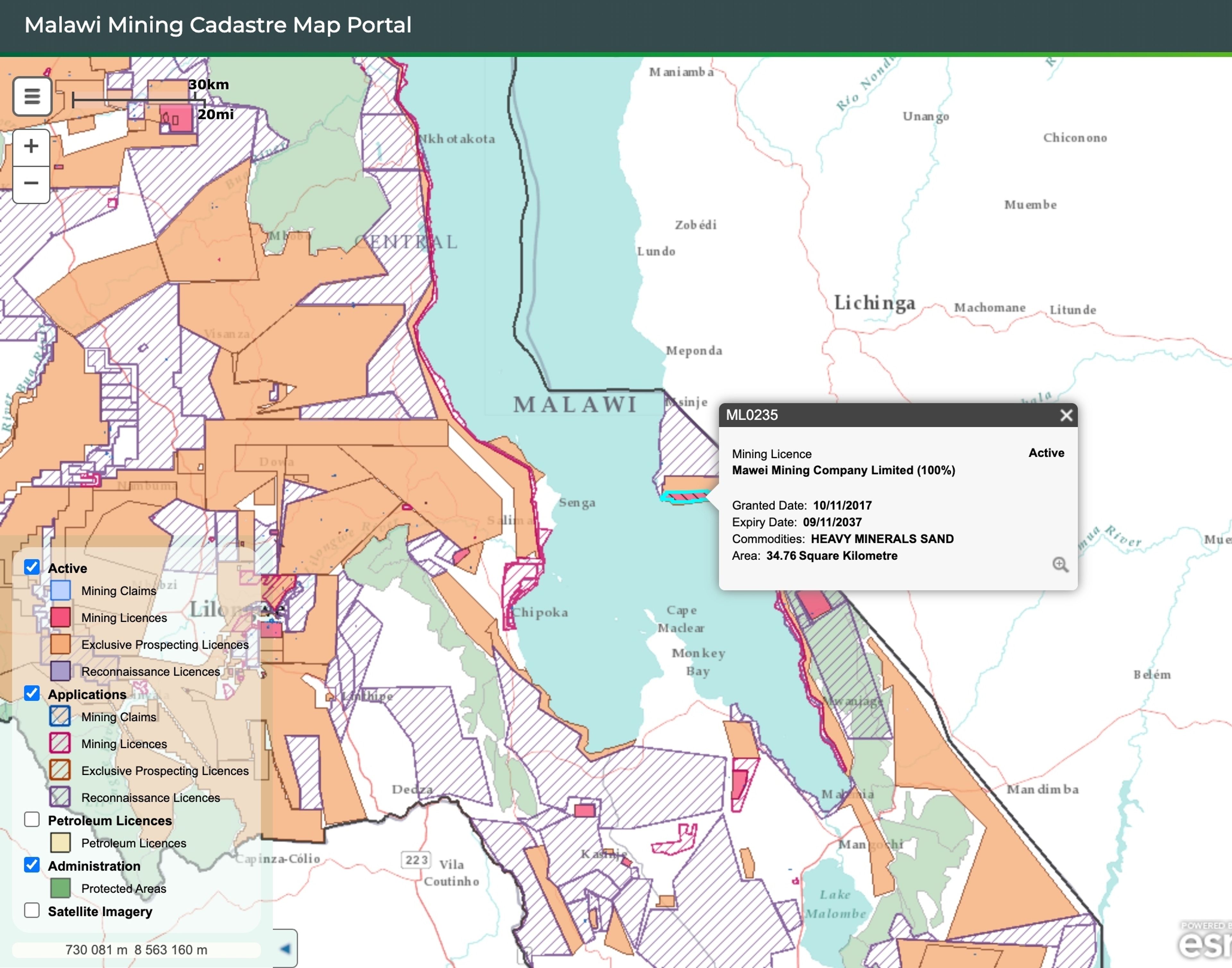
Mawei's concession, on the shores of Lake Malawi. (Credit: Malawi Mining Cadastre Portal.)
Corporate pass the parcel
Mawei is fully owned by Xinjin International Company Ltd., registered in the British Virgin Islands, a tax and secrecy haven.
Reporters found ownership of Mawei has shifted twice since 2023 as shares in Xinjin International changed hands — without legally required government approval — bringing Mawei under the majority control of Chinese authorities.
In late 2017, Xinjin International was 51% owned by private Chinese mining investment company Shenzhen Mawei Titanium Industry. The other 49% is owned by Hainan International Resources, a state-owned enterprise controlled by the Hainan regional government in southern China.

Mawei's ownership structure late 2017 when it was granted a mining licence (Image: Finance Uncovered)
According to public stock exchange filings in China, Shenzhen Mawei Titanium transferred its controlling stake in Xinjin International to another private entity, Chinese mining conglomerate Zhongrun Resources Investment Company, in return for several of its property assets in August 2023.
Two years later, with work still stalled in Makanjira, control of Mawei changed hands again — but this time to a Chinese state company. In mid-2025, Zhongrun Resources transferred its stake in Xinjin International to its top shareholder, Shandong Zhaojin Ruining Mining Industries Co., which is ultimately controlled by the Zhaoyuan municipal government in Shandong.
With these exchanges, two entities ultimately controlled by the Chinese state — Shandong with 51% and Hainan with 49% — took full ownership of one of Malawi’s strategic mineral prospects. The deal was approved by Chinese authorities, but in Malawi, mining officials didn’t even notice.

Mawei's ownership structure by the end of 2025, when it was fully owned by two companies ultimately controlled by the Chinese state. (Image: Finance Uncovered.)
After reviewing the findings, Felix Thandwe, partner at Malawian law firm Destone Chambers, said Mawei could face penalties or potentially lose its mining licence for failing to notify authorities it had new owners.
Malawi’s Ministry of Mining confirmed it had not been informed of the changes in Mawei’s ownership. It promised a “fact finding exercise” that could lead to fines or administrative penalties, but stopped short of pledging to cancel Mawei’s licence.
Cao, Mawei’s managing director, disputed they had to inform the ministry of the share transfers as its immediate owner was still Xinjin International, adding he would contact authorities for clarification.

Mawei's mining concession is thought to hold more than 350 million tons of critical minerals and rare earths. (Photo: Andrew Viano.)
‘Secrecy becomes the norm’
For Malawi, one of the poorest countries in the world, mining could be a game-changer. The sector contributes less than 1% of GDP and the government sees the country’s untapped mineral wealth as a way to transform its fortunes.
The potential prize is huge. China is expected to invest $12 billion in Malawi’s mining sector in the coming years — more than the country’s entire annual economic output in 2024.
China is eyeing millions of tonnes of rare earth deposits in the centre of Malawi. Over the last three years, Chinese delegations have toured these rare earth prospects, met with ministry officials and explored ways to enter the sector.
“The world’s superpowers need what Malawi has, and they need it now,” said an industry analyst, who requested anonymity because of his work on sensitive mineral projects.
But a World Bank study of Malawi’s extractives sector, published in May, offers an unflinching analysis of the challenges the country faces.
Its official record of licences is neither up-to-date nor fully digitised. Regulatory authorities lack the staff, resources, and equipment to effectively monitor mining sites. Malawi also has no accredited minerals laboratory, so every sample must be sent abroad to be tested.
In a system where the regulator can neither inspect nor consistently publish contracts, foreign companies face little pressure to operate transparently. Even when they are properly licensed there is little accountability: according to the World Bank, no work has been done on most of Malawi’s hundreds of mining concessions.
“When ownership is hidden in offshore structures, you cannot even tell who to hold responsible,” said Chabwera, from the Natural Resources Justice Network.
“Decisions that affect our land and people begin to be shaped by external interests. We lose our bargaining power. And secrecy becomes the norm.”
*Photo main image: Andrew Viano
*Fact-check: Malia Politzer
*Editors: Ted Jeory and Nick Mathiason